About COPD
Jan 26, 2026
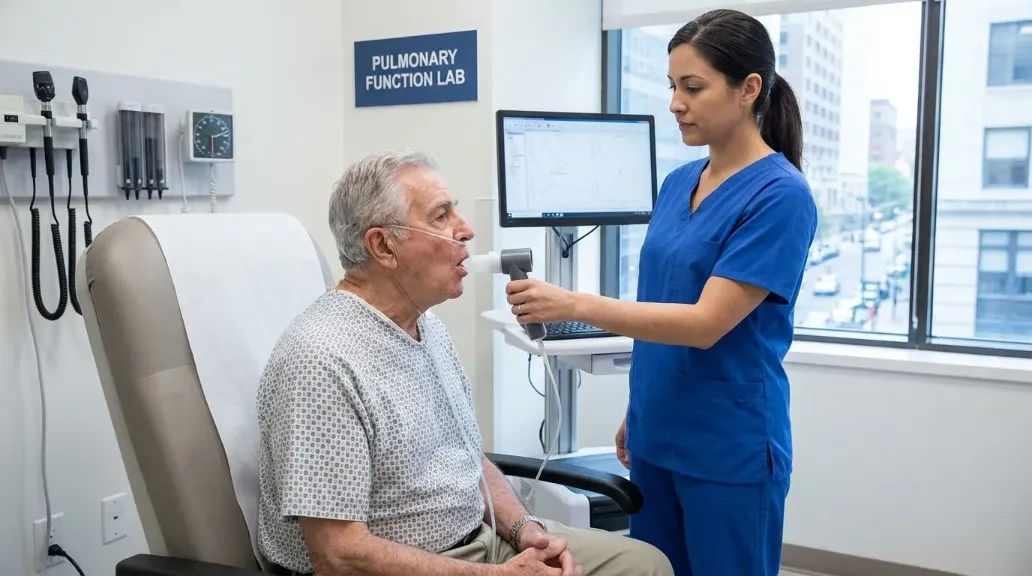
Learn how COPD is diagnosed with spirometry—a simple, non-invasive breathing test. Discover lung function testing, COPD stages (GOLD 1-4), and why early diagnosis helps slow lung damage and symptoms.
The “gold standard” for diagnosing chronic obstructive pulmonary disease (COPD) is a simple breathing test called spirometry. It’s a test that measures how much air your lungs can hold and how well the air flows in and out of your lungs.
Many people are afraid to get diagnosed with COPD. But testing is painless, non-invasive, and an important part of improving your quality of life. Early diagnosis of COPD is critical because lung damage cannot be reversed but it can be slowed. That means the sooner you’re diagnosed, the sooner you can start treatment and manage symptoms that make breathing difficult. Read on to learn how COPD is diagnosed.
To diagnose COPD, your healthcare provider will start by taking a family and medical history and performing a physical exam. It’s important to answer all questions honestly and report any symptoms you’ve been experiencing so your provider can make an accurate assessment.
Smoking is the leading cause of COPD. Your provider needs to know how many packs per day you smoked or currently smoke and how long you smoked for. Even if you haven’t smoked since childhood, this information is still important. Exposure to smoking as a child or teenager slows lung growth development and increases the risk of COPD.
Long-term exposure to other irritants can also cause COPD. Your provider will likely ask you about any dust or chemicals you’re exposed to at work. And family genetics can also play a role in COPD risk. Some people develop COPD from a rare genetic condition called alpha-1-antitrypsin (AAT) deficiency which is when the liver doesn’t produce enough AAT to protect the lungs from irritants.
When discussing your symptoms with your provider, be open and clear about what symptoms you have, when you experience them, and how often you experience them. Do you get breathless? What time of day do you cough most? Does your cough produce mucus? Keeping a journal of your symptoms can help you remember important information.
During the physical exam, your provider will listen to your chest with a stethoscope. This will help them identify any wheezing (whistling while you breathe), crackling, or prolonged exhaling (breathing out longer than you breathe in). They will also check for physical signs like barrel chest (rounded, full-looking chest from trapped air) or cyanosis (bluish tint to your skin, lips, or nails).
Spirometry is the main test that diagnoses COPD. It is a type of pulmonary (lung) function test – a test that tells how well your lungs are working. It’s done using a machine called a spirometer and measures how much air you can breathe and how well you can breathe in and out.
You’re often seated during a spirometry test. A nose clip will keep your nostrils closed while you take deep, forceful breaths in and out through a tube connected to the spirometer. Your lips need to be sealed around the tube meaning all of the air you breathe out goes into the tube. The test is typically repeated at least three times to make sure results are similar each time.
The spirometry test takes two main measurements: forced vital capacity (FVC) and forced expiratory volume in one second (FEV1). FVC measures how much air you can fully breathe out after breathing in as deeply as you can. A lower than average FVC number means breathing is more difficult. FEV1 measures how much air you can forcefully breathe out in one second. A lower than average FEV1 measurement means more blockages in the bronchial tubes.
In addition to looking at the FVC and FEV1 results separately, your provider will also calculate your FEV1/FVC ratio. This ratio estimates how much of your lung capacity you’re able to breathe out in one second. A low ratio, which will be given to you in a percentage, means something is blocking your airways. Typically a result of 70% or less means you have COPD.
Even if your FEV1/FVC ratio results show you have COPD, your provider may prescribe a bronchodilator, or inhaler, then redo the spirometry test. This is called reversibility testing. If your ratio improves after using the inhaler, then you likely have asthma, not COPD. If the number stays the same or worsens, this likely confirms your COPD diagnosis.
While spirometry is the main test to diagnose COPD, your provider may recommend additional pulmonary function tests to get more information. These tests will create a better understanding of what’s going on inside your lungs.
A body plethysmography test will measure the total amount of air in your lungs. You enter a clear, plastic box and breathe into a mouthpiece. Sensors inside the box and in the mouthpiece measure any changes in air pressure and air flow. The results of this test will show your:
Total lung capacity (TLC): how much air is in your lungs after taking the biggest breath in that you can
Functional residual capacity (FRC): how much air stays in your lungs after you breathe out regularly
Residual capacity (RC): how much air stays in your lungs after you breathe out as much as you can
Lung diffusion tests, also called diffusing capacity for carbon monoxide or DLCO, shows how well oxygen moves from your lungs to your blood. You breathe in a gas mixture of nitrogen and oxygen, a small amount of carbon monoxide, and a small amount of a tracer gas that doesn’t absorb into the blood such as methane. As you breathe, a machine will measure how much carbon monoxide your blood absorbed to show how well your lungs are working.
A pulse oximetry test is an easy, painless test that measures your heart rate and how much oxygen is in your blood. It’s usually done by clipping a small device onto your finger. This is often measured while you’re at rest. Sometimes pulse oximetry is used to monitor changes in your results while performing a six-minute walk test – when you walk at your regular pace for six minutes to see how well your heart and lungs work during light exercise.
You may also need imaging tests to see inside your lungs. A chest x-ray takes pictures of your lungs and the surrounding areas. It can show damage from COPD, but it can also rule out other potential causes such as infections like pneumonia or fluid build-up from heart failure.
A computed tomography (CT) scan takes pictures of your lungs in much greater detail than a chest x-ray. CT scans can show what type of COPD you have by detecting holes in your lung tissue from emphysema or bronchial wall thickening from chronic bronchitis. They can also show how severe your COPD is and whether you might benefit from surgery. These detailed images may also simultaneously detect lung cancer.
Blood tests can also help diagnose COPD. An arterial blood gas (ABG) test measures how much oxygen and carbon dioxide are in your blood. This result shows how well your lungs can move oxygen into your blood and carbon dioxide out of your blood.
In rare cases, COPD is caused by an AAT deficiency. An AAT deficiency blood test will determine if you have this genetic disorder. Typically anyone diagnosed with COPD should be tested for AAT deficiency, especially if there is a family history of AAT or you’re diagnosed with COPD before age 55.
So how do the results of all these tests get you to your COPD diagnosis? Providers use guidelines from the Global Initiative for Chronic Obstructive Lung Disease (GOLD). GOLD is an organization that works with the National Heart, Lung, and Blood Institute (NHLBI), National Institutes of Health (NIH), and the World Health Organization (WHO) to create evidence-based awareness programs, diagnosis guidelines, and treatment plans for COPD.
GOLD guidelines base the staging of COPD on your symptoms, how many times you’ve had a symptom flare-up (called exacerbation risk), how many times you’ve been in the hospital because of your symptoms, and the results of your spirometry tests.
Results from your spirometry test are broken into four grades:
GOLD 1: Mild (FEV1 is 80% or higher)
GOLD 2: Moderate (FEV1 is between 50-79%)
GOLD 3: Severe (FEV1 is between 30-49%)
GOLD 4: Very Severe (FEV1 is below 30%)
Your GOLD level, exacerbation risk, and symptoms are then further categorized into groups:
Group A: GOLD 1 or 2 with mild symptoms, no hospitalizations in the last year, and minimal flare-ups.
Group B: GOLD 1 or 2 with more symptoms than Group A, no hospitalizations in the last year, and potentially one major flare-up.
Group E (formerly separated as Groups C and D): GOLD 3 or 4, more than two flare-ups in the last year or a hospitalization in the last year.
When it comes to COPD testing, there are a lot of myths and false information. Check your knowledge:
Myth or Fact? You can diagnose COPD with just a stethoscope.
Myth – You need a spirometry test to diagnose COPD. And your provider may order other lung function tests, imaging, and blood tests to help with the diagnosis too.
Myth or Fact? Testing is painful.
Myth – Testing is not painful, and most testing is non-invasive as well. Usually a diagnostic test will just require you to breathe forcefully into a machine.
Myth or Fact? If I stop smoking, I don't need to test for COPD.
Myth – Lung damage can be slowed down, but it can never be reversed. The sooner you quit smoking, the better your symptoms may be. But once you have COPD, the lung damage is already there. Testing will confirm whether you have COPD.
Myth or Fact? I'm too old for testing to matter.
Myth – Treatment can help at any age. COPD treatment focuses on slowing lung damage and managing your symptoms so you can breathe easier and improve your quality of life.
Myth or Fact? X-rays show everything.
Myth – Early stages of COPD often don't show on an x-ray. To diagnose COPD, you will need to take a spirometry test, and you may need additional lung function tests, imaging, and blood tests as well.
Can I test myself for COPD at home?
No, you cannot test for COPD at home. You need to see your healthcare provider for a spirometry test. You may also need other lung function tests, imaging, and blood tests to confirm your diagnosis.
How long does a spirometry test take?
A spirometry test usually takes about 15 to 30 minutes to complete.
Does insurance cover COPD testing?
Most private insurance, Medicare, and Medicaid plans will cover some or all of COPD testing if it’s deemed medically necessary.
What is the difference between asthma and COPD on a test?
A spirometry test can diagnose asthma or COPD. To determine the difference between the two, your provider will give you a bronchodilator (inhaler) reversal test. This means you’ll be given an inhaler and after using it, you will take the spirometry test again. If your results improve, you likely have asthma, not COPD.
Does a low FEV1 score mean I need oxygen?
A lower FEV1 score means you have more blockages in your airways making it harder to breathe. This doesn’t always mean you need oxygen, but using oxygen may improve your symptoms.
How often should I get tested if I smoke or have a smoking history?
If you smoke or used to smoke and you have any symptoms of COPD, you should talk to your healthcare provider about testing for COPD. If you are diagnosed with COPD, your provider will discuss how often you should be tested for regular monitoring as part of your treatment plan. This might be as often as every two weeks or as spaced out as every six months.
Is the test difficult for people who are claustrophobic?
Generally, people don’t find spirometry tests to trigger their claustrophobia. You will sit freely on a chair, have a clip placed on your nose, and breathe through a tube into a machine.
A COPD diagnosis can be scary. It’s understandable if you’re overwhelmed by testing. But testing is the gateway to breathing better. Testing for COPD is easy and non-invasive. Once you have a confirmed diagnosis, your healthcare provider can build a treatment plan with you to help manage your symptoms and improve your quality of life.
Lung damage can’t be reversed, but it can be slowed with proper treatment. Don’t wait until coughing and other symptoms become unmanageable. If you are over the age of 40 and experiencing symptoms, especially if you smoke or used to smoke, talk to your provider about getting a spirometry test.
Related Articles